
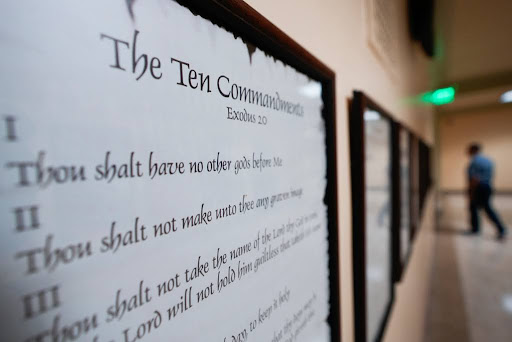
In late February, the 5th U.S. Circuit Court of Appeals voted to lift a lower court’s block on a Louisiana law mandating poster-sized displays of the Ten Commandments in public school classrooms. In the decision, the majority determined that the facts presented were insufficient to permit judicial judgment, as they were uncertain of the context and rationale behind the religious posters.
Certainly, it is essential to have all of the facts before making a decision about a gray area. In two narrowly decided Supreme Court cases, the Court issued rulings both allowing and disallowing the public presentation of the Ten Commandments. McCreary County v. ACLU of Kentucky included a 5-4 majority decision holding that displays of the Ten Commandments in public schools and courthouses were unconstitutional due to the Establishment Clause of the First Amendment. The same year that case was decided, however, the very same Court issued a 5-4 ruling in Van Orden v. Perry, allowing a Ten Commandments monument in a state capitol building. The difference? Justice Stephen Breyer, the deciding vote in both cases, took seemingly contradictory positions. However, while Breyer believed the Ten Commandments display in McCreary County sought to “advance religion,” in Van Orden, he believed a non-religious message surrounding Texas’ history and culture dominated. These opposing cases reveal the importance of governmental intent in determining whether a display violates principles of separation of Church and State.
Louisiana Senator Jay Morris has defended the law, stating that the purpose of the bill is not “solely religious” and that the Ten Commandments are “simply one of many documents that display the history of our country and foundation of our legal system.” Although proponents of the law like to claim this, the circumstances reveal otherwise.
The law specifies that the posters will be hung up with a message simply containing historical information, and that other historical displays like the Mayflower Compact and Declaration of Independence may also be allowed, but these superficial additions are simply not enough. In Van Orden, the monument stood in a large park with 17 monuments and 21 historical markers, with no special emphasis on the Ten Commandments. By contrast, the Louisiana law requires the Ten Commandments to be shown in every classroom, regardless of subject, while the few other documents mentioned are merely suggestions. In a small classroom setting, the inherently religious document will receive greater attention, regardless of any secular framing through small subtext or the presence of a few optional accompanying displays.
Furthermore, in Van Orden, the monument had been up for 40 years before it was legally challenged. Those many years suggest that the public had not perceived the monument as carrying a primarily religious message, otherwise there would have been more immediate backlash. In this case, the same cannot be said. The bill’s author, Republican state lawmaker Dodie Horton, has explicitly stated that she hopes implementing the Ten Commandments in public schools will install a “moral code” in classrooms. This statement reveals an intention to advance religious practices in public education, rather than just acknowledging historical influences. Identifying the Ten Commandments, a clearly Christian doctrine, as the single most important moral foundation, prioritizes a specific religion within a government entity. The public is aware of this religious implication, which is why the law is being vehemently fought in Court and strongly protested by those belonging to other religions, for example, by Jewish groups who “hold the Ten Commandments in high regard within Judaism,” but find issue with promoting them as “fundamental moral teachings.”
Beyond Constitutional questions, the law poses a challenge to the inclusivity of public schools, leaving students and educators of other faiths in a difficult position. This is especially worrisome, given that the Louisiana law is just one small part of an alarming trend to manipulate education through greater integration of explicitly Christian religion. Other states like Ohio, Texas, and Arkansas are attempting to pass similar laws.
Mandating the display of the Ten Commandments in every classroom effectively privileges one religion, violating the Establishment Clause and fostering alienation. Religion and public education — and more broadly — religion and government, must remain separate. No matter what historical arguments lawmakers may make, their non-secular intentions are clear. The Court of Appeals in the Louisiana case set a troubling precedent that warrants serious reconsideration by a higher court.
The Zeitgeist aims to publish ideas worth discussing. The views presented are solely those of the writer and do not necessarily reflect the views of the editorial board.