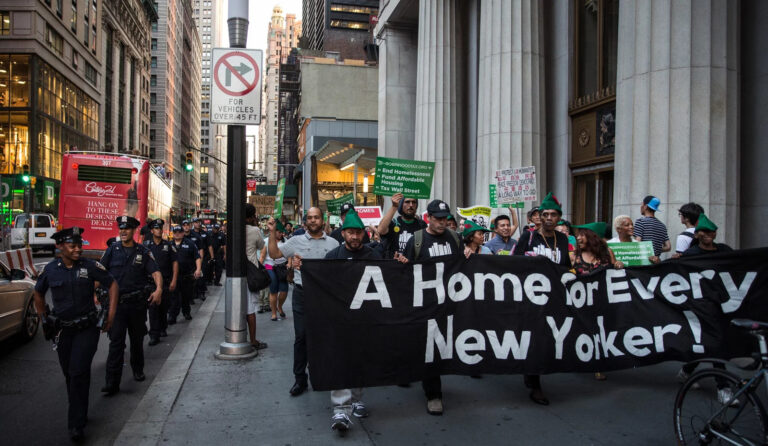

America is engulfed in a national housing crisis — or at least its cities and suburbs are. Discussion of housing affordability has steadily grown in American political discourse, especially at the local level. Politicians across the nation have incorporated the issue into their platforms, agendas, and rhetoric. But to call it a national crisis would blur reality; housing shortages are not evenly distributed across the fifty states. In fact, states that favor the Democratic Party bear the brunt of the U.S. housing shortage.
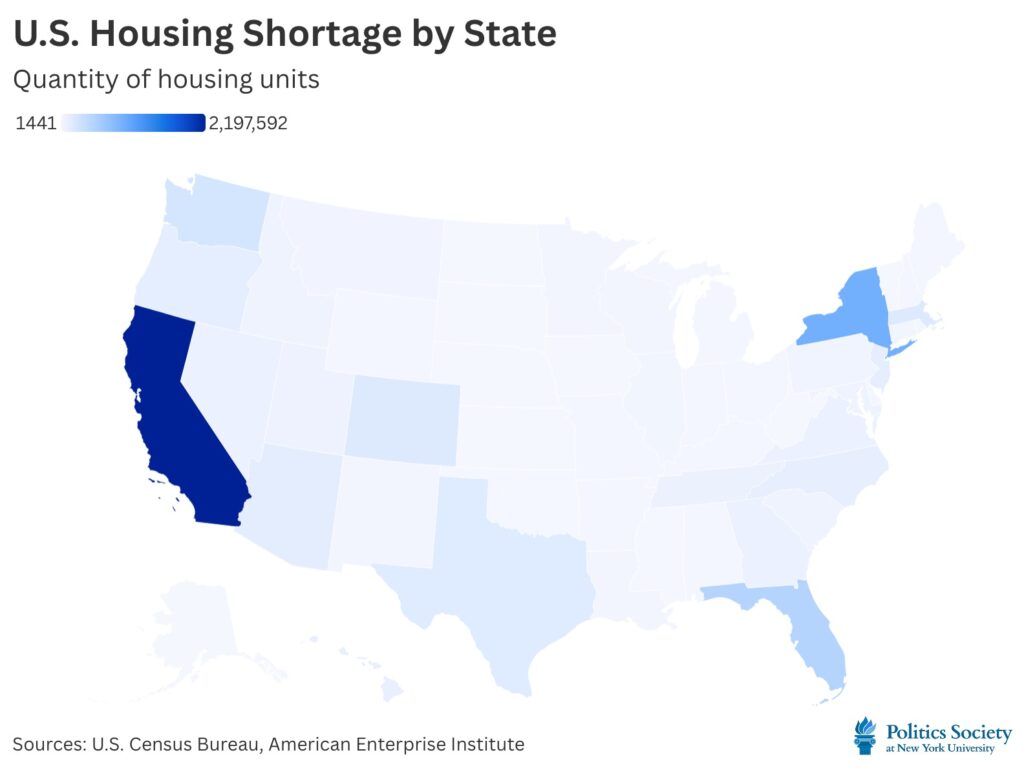
The crisis reaches its greatest intensity in New York and California, the two most-populated states won by Kamala Harris in 2024. According to the American Enterprise Institute’s analysis, these Democratic strongholds are short by roughly 957,639 and 2,197,592 homes, respectively. Adjusting the data by each state’s population illustrates how the crisis extends beyond these two states. The shortage is largely concentrated in the west, along with some East Coast states. In much of the heartland, however, there is hardly any crisis at all.
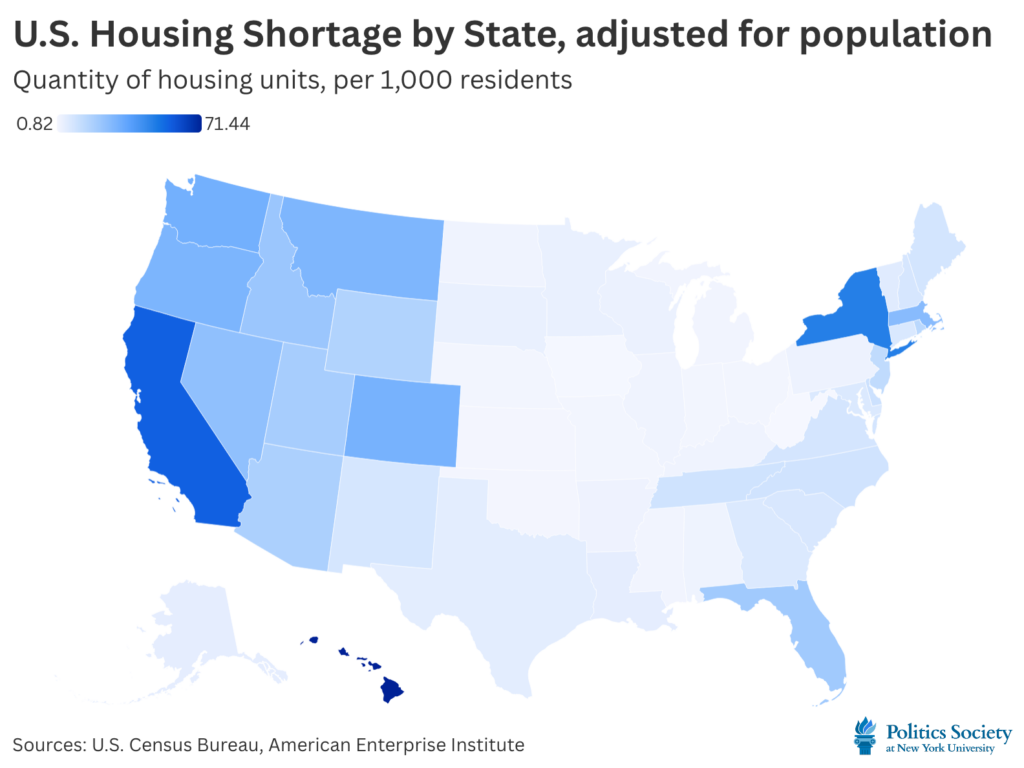
The six states with the proportionally worst shortages — Hawaii, California, New York, Colorado, Washington, and Oregon — each have Democrat-held governorships and state legislatures (a Democratic trifecta). In total, the 16 states with Democratic trifectas are short roughly 4.4 million housing units, or 33 homes per 1,000 residents. Conversely, the 23 states with Republican governments need only 1.1 million homes, which translates to 8 per 1,000 residents.
Politics alone does not entirely explain the differences between the states by partisan lean. Public policies restraining housing construction — like restrictive zoning laws — are largely to blame for the crisis, but the debate crosses partisan lines. There are NIMBY (Not In My Back Yard) voters and politicians in both parties. Neither party currently offers a unified vision on housing policy.
In that case, why is the crisis concentrated in blue states? Large cities are the epicenters of the housing crisis — not rural towns. Though both are experiencing cost increases, the scale is greater in cities due to a higher quantity of homes — in particular, rental units. The Democratic base, of course, is concentrated in urban centers, which explains why blue states suffer the harshest housing shortages.
The housing crisis is not only a problem for homeowners and renters, but also for the Democratic Party itself. By not building enough housing, states like California and New York have inadvertently diminished their own political power. After each losing a congressional district following the 2020 census, researchers now project that California will lose four and New York will lose two by next decade. By restricting housing construction, these states have artificially constrained their populations. It will cost Democrats votes in the House of Representatives and Electoral College.
There is still time for California, New York, and other blue states to turn the tide. Congressional reapportionment will be decided by the 2030 census and enacted for the 2032 midterms. Before then, the Democrats must cement themselves as the pro-housing party.
Democratic governors and legislators must use the tools of state government to spur the construction of new housing. California recently passed a bill to legalize new housing near transit stations. Illinois passed a similar bill eliminating parking mandates near transit stations. These measures, unfortunately, do not go far enough. State governments must pass even further sweeping legislation to end exclusionary zoning and other impediments to homebuilding.
The housing market can change quicker if lawmakers bypass the local level. Instead of each individual municipality making gradual liberalizing reforms, the state can resolve the issue in one fell swoop.
Further, state-level action avoids the problem of fragmentation. Multiple municipalities in a single housing market could have different policies, with one dragging up the other’s rents. Currently, Minneapolis and St. Paul have diverging policy agendas; Minneapolis’s approach has resulted in a housing boom, while St. Paul’s has had the opposite effect. Instead of this needless dissonance, the state government of Minnesota should step in to address the issue. Minneapolis’ example demonstrates that local action can produce positive results, but Democratic lawmakers cannot treat it as the only pathway to policy change.
If blue state governments effectively respond to the crisis, they could turn their electoral problem into an advantage. The shortages are fundamentally a product of excess housing demand — a level of demand not seen in red states. If blue states can build the necessary homes, the accompanying population increase would add new congressional districts to their cities and entirely reverse the current trend in apportionment.
The Zeitgeist aims to publish ideas worth discussing. The views presented are solely those of the writer and do not necessarily reflect the views of the editorial board.