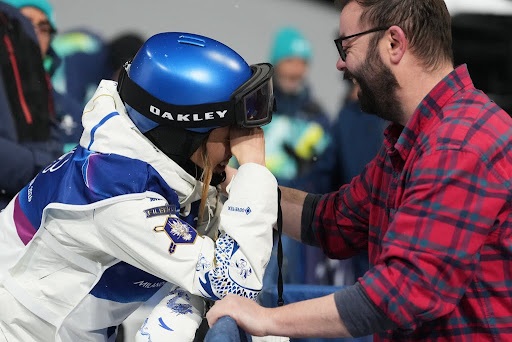
When Eileen Gu glided onto the slopes of the 2026 Winter Olympics in Milan and Cortina, the atmosphere was markedly different from the feverish adulation of Beijing 2022. Four years ago, Gu was the most popular female athlete in China. She became the first freestyle skier to win three medals at a single Winter Olympics. However, her decision to compete for China while being trained in the United States has drawn worldwide attention and discussion. In 2026, despite securing two silver medals, the state-led propaganda apparatus remained uncharacteristically muted. Gu’s career has become an example of how China’s strict prohibition of dual citizenship can be quietly suspended when national interest is at stake, creating a tier of “super-citizens” who navigate borders with a privilege denied to millions of ordinary Chinese.
Born in San Francisco and currently a student at Stanford University, Gu received her elite ski training entirely within the United States. This American foundation has translated her into a global commercial empire. According to Forbes’ 2025 list of the world’s highest-paid female athletes, Gu ranked fourth globally, earning a spot alongside the world’s most elite tennis stars.
The Chinese state’s willingness to overlook its own laws for Gu stands in stark contrast to the rigid enforcement faced by others. Under Articles 8 and 13 of the Chinese Nationality Law, dual citizenship is strictly prohibited; naturalizing in another country typically results in the automatic loss of Chinese citizenship. The law should never be selectively enforced. If Articles 8 and 13 of the Nationality Law can be temporarily set aside for the sake of winning gold medals, then where is the authority of the law?
There is no doubt that Eileen Gu is exceptional. She has also become China’s most successful case of naturalizing athletes to enhance its performance in international competitions and demonstrate soft power. However, the unsuccessful examples have not been as fortunate as she has been. For instance, figure skater Zhu Yi, who was born in the United States just like Eileen Gu but switched to compete for China, returned empty-handed after failing to achieve success in the competition. The same nationalist crowds that cheered Gu’s “patriotic choice” turned on Zhu with vicious cyberbullying.
On Weibo, China’s Twitter-like platform, the hashtag “Zhu Yi has fallen” gained 200 million views in just a few hours. “This is such a disgrace,” said a comment with 11,000 upvotes.
According to the Olympic Charter (Rule 40-41), any competitor in the Olympic Games must be a national of the country of the National Olympics Committee which is entering such a competition. A competitor who is a national of two or more countries at the same time may represent either one of them, as he may elect. However, once an athlete represents a country in a major international competition, they cannot switch to another country except under specific conditions.
Eileen Gu has never explicitly stated her national identity. In 2022, she commented, “I definitely feel I am Chinese as I am American; I am American when I’m in the US, and I am Chinese when I’m in China.” In May 2023, Hu Guangyu, former deputy director of China’s Olympic Preparation Office and the person responsible for Gu’s naturalization, was placed under investigation for serious disciplinary violations and illegal activities. This leaves the question of whether Gu truly renounced her American citizenship unanswered.
This ambiguity becomes harder to maintain as political scrutiny intensifies across the Pacific. In an interview with Fox News on Feb. 17th, 2026, US Vice President J.D. Vance suggested that American-born athletes should represent the US in international competition.
“I certainly think that somebody who grew up in the United States of America, who benefited from our education system, from the freedoms and liberties that make this country a great place, I would hope that they want to compete with the United States of America,” Vance said. “So, I’m going to root for American athletes, and I think part of that is people who identify themselves as Americans. That’s who I’m rooting for in this Olympics.” Asked specifically about Gu, Vance admitted that he had “no idea what her status should be” and that it “was up to the Olympic committee.”
By serving as an ambassador for the Salt Lake City 2034 Olympic bid while competing for China, Gu was criticized for being “double-sided.” To Americans, she looks like a defector chasing Chinese market millions. To Chinese netizens, she looks like an opportunist who uses China for fame while keeping her heart and her passport in the West. The trajectory of Eileen Gu reveals that national identity has become a tradable commodity for the elite. China’s willingness to ignore its own Nationality Law for Gu proves that legal principles are often subordinate to national interests. If China continues to grant legal exemptions only to the wealthy and the victorious, it risks alienating a public that increasingly demands fairness over medals.
The Zeitgeist aims to publish ideas worth discussing. The views presented are solely those of the writer and do not necessarily reflect the views of the editorial board.