Sarah Holder / Bloomberg
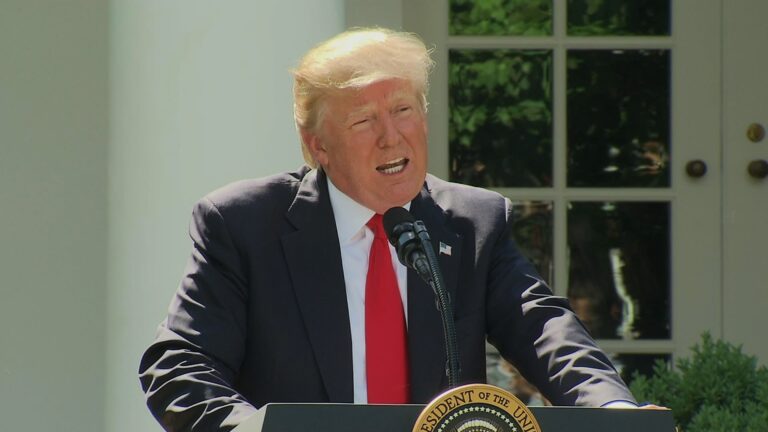
Imagine trying to put out a forest fire by banning matches. Fruitless, right? That faulty logic is precisely what dooms President Donald Trump’s new executive order, which bans the corporate acquisition of single-family residences (SFRs) in an attempt to lower housing prices. Ultimately, Trump aims to address the bipartisan concern about surges in housing prices across the country, which all political parties agree have plagued the nation for several years.
Trump’s Axe Swing at Rising House Prices
According to the White House, the order directs federal agencies to “prevent agencies from the acquisition by an institutional investor of a single-family home that could otherwise be purchased by an individual owner-occupant.” Trump has made his position clear: homes belong to families, not corporations.
Trump claims that corporate landlords are the culprits behind rising housing prices. However, the facts disagree: as Josh Boak from AP News reports, institutional investors are “only a tiny sliver of home buyers, accounting for just 1% of total single-family housing stock.” If corporations were truly the problem, they would inferably have a much larger presence in the market.
Instead, the cause of the crisis, according to Boak, is structural scarcity. He notes that Goldman Sachs estimates that “3 to 4 million additional homes would need to be built” to truly lower prices. Trump’s executive order blames corporations for an issue they didn’t create. In fact, after closer analysis, it’s quite the opposite.
Cutting off Capital in a Supply Crisis
Institutional investors are not merely buying homes; they are actively building them. Last month, Invitation Homes “acquired Resibuilt, a Southeast-focused build-to-rent (BTR) developer,” accounting for “81% of the single-family acquisitions.” Similarly, AMH acquired 587 homes during the third quarter of 2025, accounting for “92% of its acquisitions.”
Even though the order has exemptions for BTR bans, cutting off institutional buyers significantly risks cutting off the capital that finances those new builds. Liz Kieche, a real-estate journalist, points out that “private equity stocks sank after Trump banned institutional investors from buying single-family homes,” as Invitation Homes’ stock slid 6.9 percent, American Homes dropped 6.7%, and NexPoint plunged 16 percent.
Housing markets obey basic economic principles: when supply expands, prices drop. When supply tightens, prices increase. Eric Levitz, a senior correspondent at Vox, explains that “the more rental homes on the market, the lower the rents will be,” and that “… institutional investment often finances the construction of new houses.” Levitz argues that in Atlanta, “rents … would be 2.4 percent higher today in the absence of Wall Street.” Capital is to a supply crisis what oxygen is to living beings.
Lastly, the cherry on top: legal uncertainty compounds the risk. According to PA Global (2026), “property ownership regulation falls under state jurisdiction,” and a “federal ban [that is based] on the Commerce Clause” would inevitably face due-process challenges. Lawsuits stall projects. Stalled projects reduce supply, further raising prices.
The Lesson to Learn
Trump’s executive order provides a clear enemy and a satisfying headline, but narrowing the buyer pool does not build homes. If America is short millions of houses, targeting institutional buyers is like fencing off one corner of a burning forest and declaring victory.
Until the country confronts the construction deficit, the housing market will remain a game of musical chairs, and no executive order can create seats that were never built.
The Zeitgeist aims to publish ideas worth discussing. The views presented are solely those of the writer and do not necessarily reflect the views of the editorial board.