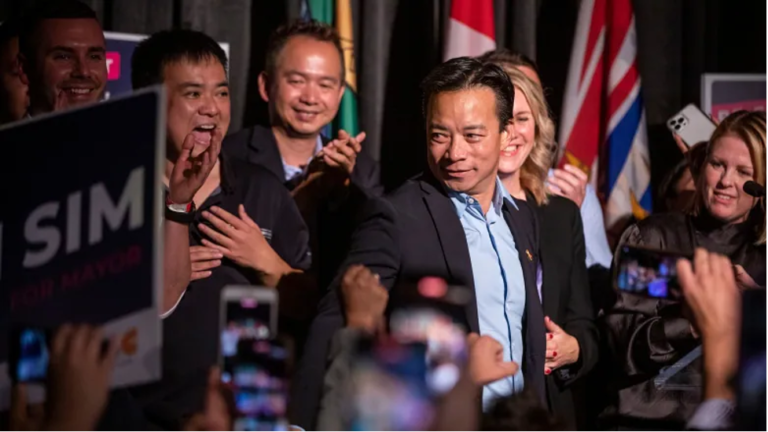
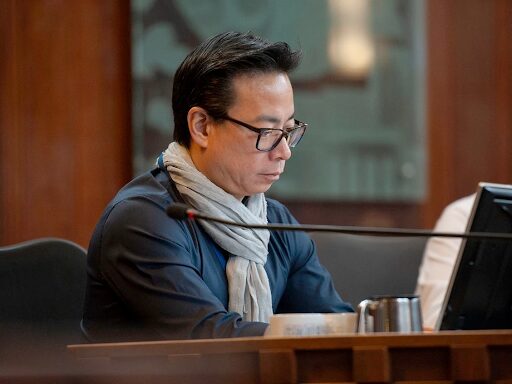
Vancouver’s mayor is in trouble. Ken Sim’s A Better City (ABC) candidates suffered a resounding defeat in a high-turnout byelection to progressive challengers, and the mayoral election is just 18 months away. These results are a drastic reversal from their initial blowout victory, where, along with the mayorship, ABC candidates won majorities on the city council, school board, and park board. Vancouver handed Sim a conclusive mandate on promises of fiscal restraint, housing reform, and a smaller, more efficient government. Three years later, he’s left a record of ineffectual and corrupt leadership with little progress on the issues of affordability facing Vancouver. Sim’s tenure provides a clear example of the pitfalls of treating politics and governance like a business.
Sim has regularly engaged in blatant corruption as mayor. The independent integrity and ethics commissioner found that Sim and numerous other ABC council and park board members violated the city’s open-meeting principle by conducting secret meetings and online communication via personal emails to predetermine votes. In response, ABC attempted the absurd move to suspend the integrity commissioner, Lisa Southern, from her post and pause all pending and future investigations. When questioned, every ABC councillor denied wrongdoing despite emails labeled “Team Voting Rules” being sent by the mayor’s office that specified that all votes are “whipped” and objections need to be forwarded in advance. Additionally, emails were sent by ABC councillors to the mayor’s office asking for clarification on how they should vote. This careless disregard for procedure and transparency has been consistent throughout Sim and his party’s tenure.
Nowhere is Ken Sim’s use of the mayoral office for personal gain more obvious than in how he’s managed the city budget. Despite promises of cutting the mayor’s budget, the council successfully passed an amendment increasing the budget for Sim’s personal office by $100,000 and $80,000 to his clerk’s office for the explicit purpose of providing “administrative support” to the mayor. This pushes Sim to spend almost half a million more than his predecessor, Kennedy Stewart. Per reporting by Justin McElroy from the Canadian Broadcasting Corporation, Sim’s justification is that Vancouver needs to be a “world-class city,” and to do this, the mayor needs to travel to more events to negotiate contracts. Frankly, I think the priority of a mayor should be to stay and serve their constituents instead of taking taxpayer-funded trips. Maybe Ken Sim should actually focus on making sure ABC stands for A Better City instead of Always Being Corrupt.
In another attempt to avoid focusing on local issues, Sim has made a heavy push for the city to invest directly in Bitcoin. Sim has stated that Bitcoin was “a hill that I’m willing to die on” and introduced a motion allowing the city to accept taxes and fees in Bitcoin and for financial reserves to be used to purchase Bitcoin as a means “against the volatility, debasement, and inflationary pressures of traditional currencies.” It’s important to note that Sim personally invests in two Bitcoin operations and promised to personally donate $10,000 worth of Bitcoin to the city if it passes, despite his own claims of being cleared from a conflict of interest. It’s worrying to see the mayor attempt to overturn city regulations in pursuit of throwing city resources into a volatile asset. Sim’s crypto obsession is more evidence of the financial crankery that has rendered him incapable of delivering on policy.
In terms of actual governance, Sim has been incompetent at addressing the housing crisis, the most important issue facing Vancouver residents. ABC’s proposed housing plan during the election was weak on details and filled with policies that would do little to increase housing supply, as I explained in an article after Sim’s victory. ABC council members consistently oppose or undercut densifying rezoning proposals, and recently successfully voted against approving a capital grant for 81 units of subsidized social housing with revenue from the empty homes tax. In 2023, the council returned $3.8 million collected from the empty homes tax to developers instead of utilizing it to fund social housing, as the revenue is intended.
When it comes to zoning reform, Sim suddenly seems to have little appetite for the deregulations that would create market-rate housing. While Sim deservedly touts the multiplex reforms passed by City Hall, the reforms are still deeply insufficient. Firstly, Sim deserves nearly no credit for this policy as he was functionally handed it by his predecessor. Moreover, official estimates from city staff project only 150 multiplex applications, not builds, per year. Additionally, limits on floor space ratio (FSR) and building height constrain the viability of developments. The multiplex law sets the FSR for multiplexes at 1.0, just barely above that of detached homes at 0.86. Setting such a low FSR only prevents developers from being able to construct dense housing and handicaps the entire purpose of multiplex reform.
In 2023, Sim and ABC shut down Councillor Christine Boyle’s proposal to diversify the wealthiest and heavily zoned neighborhood in Vancouver, “with new infill and multi-family housing” and support for subsidized housing. In addition to refusing to make these wealthy neighborhoods do their part in building housing, Sim actively promotes further gentrification in vulnerable neighborhoods such as the Downtown Eastside. ABC’s election platform only explicitly specified their support for densifying the Hastings Corridor in the Downtown Eastside.
The city of Vancouver has been floundering under Sim, and its residents look like they’re ready to turn a new leaf. A challenger to Sim must focus on restoring integrity to the mayoral office and city council and thoroughly investigate complicity by staff in Sim’s corruption. Most importantly, they must aggressively remediate the effects of budget cuts and accelerate market-rate and subsidized housing development to create the vibrant and affordable city Vancouver is meant to be.
The Zeitgeist aims to publish ideas worth discussing. The views presented are solely those of the writer and do not necessarily reflect the views of the editorial board.