
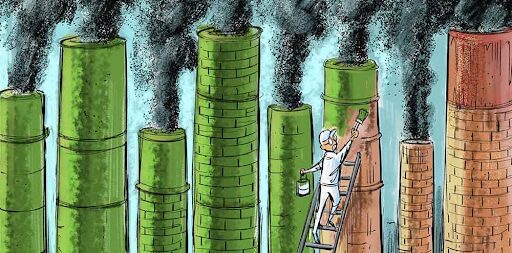
Everywhere you look, brands promise a greener world, flaunting the words “sustainable,” “eco-friendly,” and “natural.” Green vocabulary has trickled down into everyday marketing language that finds its way to every clothing tag, snack package, or airline ad. It’s almost as if America has finally checked off the box of environmental sustainability. However, with a closer look, seemingly optimistic claims dissolve quicker than a compostable straw in hot water.
This new corporate norm is titled greenwashing: when companies fabricate environmental efforts to create the illusion of a sustainable company. Scholars on ResearchGate define greenwashing as communication that exaggerates environmental performance to obscure the gap between symbolic claims and genuine environmental action. In other words, while the marketing looks green, the impact usually does not.
The Widespread and Growing Problem
Greenwashing is no fringe marketing trick — it’s widespread across global industries. A multinational review by consumer protection authorities found that 40 percent of environmental claims online may be misleading, according to the U.K. Government Report. Indeed, data from the RepRisk ESG Data Review has discovered that one in four climate-related corporate controversies involves greenwashing.
These statistics matter because misleading sustainability claims divert attention from consumer trust that would otherwise hold companies accountable for doing the actual work of lowering emissions. According to the U.N. Climate Programme, the United Nations warns that greenwashing significantly undermines genuine climate action and increases public confusion. Consumers feel the impact too, with Sustainability News reporting that 54 percent of customers stated they would stop buying from a company that was caught greenwashing, according to a survey that polled over two thousand adults from the United Kingdom.
The Calculus Behind Greenwashing
Corporations almost never make outright false claims. Rather, companies tend to lean on vague language with intentional ambiguity to signal environmental purity to the average consumer. Business News Daily writes that greenwashing involves using vague terms without supplying a definition, like “eco-conscious” or “planet-safe.” Alternatively, companies also may emphasize infinitesimal improvements but ignore enduring problems of higher importance, such as a water company using recyclable caps but maintaining plastic bottles. Subtler strategies exist too — for instance, using earthy colors (e.g., blue and green) and nature imagery (e.g., trees or Earth) on packaging to imply sustainability.
How To See Past The Green Glitter
Consumers ought to look for measurable sustainability rather than aesthetics to avoid falling for greenwashing. One can look for specific data, yearly emissions targets, and third-party certifications to hold companies accountable. Genuinely environmental corporations will set company-wide sustainability standards with transparent and public reports that consumers can easily find, with independent third-party organizations agreeing and endorsing the data that a company supplies. Essentially, if a claim has more adjectives than numbers, it’s probably a form of greenwashing.
Why Attention Matters
Greenwashing thrives when consumers assume every green leaf icon equals progress. But change actually happens when we look beyond slogans and ask simple questions, like where the quantifiable data is, who verified that data, and what the results are. Branding rarely causes climate action in itself; measurable improvement and public pressure actually get the job done. The next time a product promises to “protect the planet,” look past the marketing glow and research the actual data. After all, sustainability isn’t a vibe, it’s proof.
The Zeitgeist aims to publish ideas worth discussing. The views presented are solely those of the writer and do not necessarily reflect the views of the editorial board.