Will the scion of the Kennedy family be the one to “do better” because America “deserves better”?
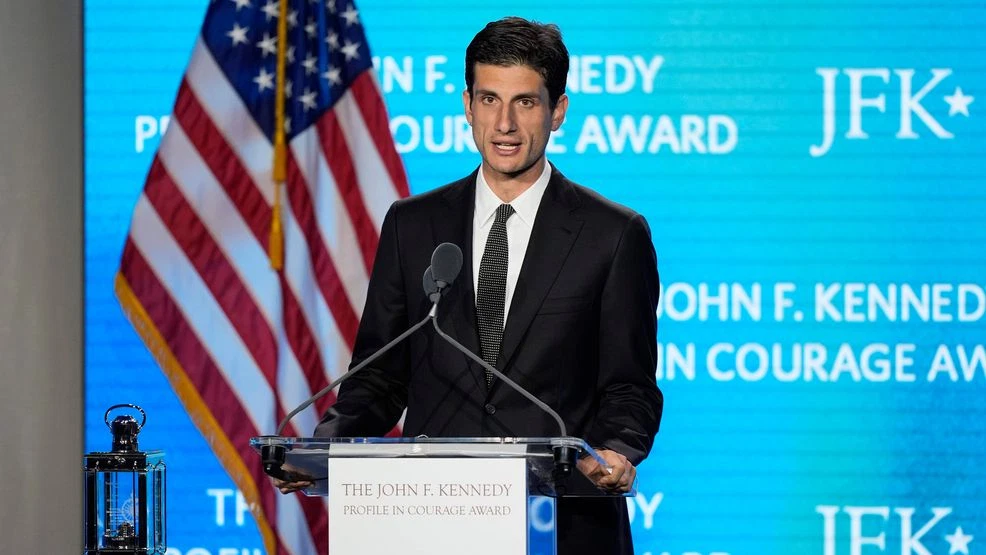
A vacancy in New York’s 12th congressional district — encompassing the UN, Empire State Building, Times Square, and Central Park — is left with Rep. Jerry Nadler’s announcement in Sept. that he won’t be running for reelection. Jack Schlossberg, 32, the grandson of President John F. Kennedy, thinks that he’s up for the job. The one to deliver “better” to the people. Not just within his district, but America as a whole. He announced his intention to run on Nov. 11 via Instagram and TikTok on the premise that U.S. democracy is in a state of crisis under the Trump Administration, stating, “250 years after America was founded, and our country is at a turning point. It’s a crisis at every level … It’s a corruption crisis … It’s a constitutional crisis with one dangerous man in control of all three branches of government … We deserve better, and we can do better.”
While it is too early to call upon his campaign strategy, so far, it is built upon a “departure” from the typical path of a Kennedy involved in politics. Schlossperg may have gotten started with his public life by serving as a pager for his great-uncle, Ted Kennedy, and family friend, John Kerry, but to say that working at a surf shop and writing for Vogue is a common tradition of his family’s path into public service would be misleading. He has made his name familiar to the public, even if his last name isn’t Kennedy. From the 1.7 million followers amassed from X, Instagram, and TikTok, he has solidified his place within the consciousness of Americans — at least the youth. But maybe that’s because they’re attracted to his perceived charisma and the curated white-knight image.
To separate Schlossberg from the Kennedy family, though, would be impossible. No matter how much he tries to delineate himself from the rest of his family, unwillingly, the public associates his person with his family’s legacy. The dynasty’s name is too strong for the average citizen to ignore. Having been raised in the Upper East Side, gone to a prep school in the Upper West, and attended Yale for undergrad and Harvard for a joint business and law degree, he also can’t separate himself from the elite status he attained from his connections.
A better question would be, “How viable is his candidacy, given that he’s a Kennedy and he has a large social media presence?”
Schlossberg’s ties to a prestigious political lineage shouldn’t disqualify him automatically. Rather, it only bolsters his qualification — at least to the public. His background just draws in the aspect of privilege — almost nepotism in a sense. Even though his campaign operations seem to reflect his efforts to detach himself from the privileges being part of the Kennedy family affords, with no sign of high-priced strategists or pollsters, in the end, he’s still a Kennedy. Directly, he does not accept financial support from his family in his endeavors, other than from his mother; his ties alone carry weight. One voter cue is name recognition. How can one not immediately recognize the Kennedy name, even disregarding JFK as a former president? Generations of this family have been involved in politics. They even have a foundation in their name. They have generational wealth and prestige, too. Even if Schlossberg isn’t qualified in terms of competency, he’s qualified in the sense that he will garner a share of votes from his — or technically, his family’s — reputation.
Perhaps, despite his “silly goose” and unserious presence on social media, his status is the reason he is still viable. Had he not hailed from the Kennedy family, he would be dismissed immediately. No one would consider him fit for office, at least not with his more questionable posts:
- Attacks toward his cousin, Robert F. Kennedy Jr., the Secretary of Health and Human Services, involving vicious insults.
- Hounding his other cousins for not attacking R.F.K. Jr. enough — either not fast or vehemently enough.
- Used the “c” word to insult Cheryl Hines, R.F.K. Jr.’s wife, and Megyn Kelly
- Asking his followers who was hotter: Mrs. Vance or his grandmother, Jacqueline Bouvier Kennedy Onassis?
- Lip-syncing to songs like Taylor Swift’s “Love Story.”
- Offering dating advice.
This is not to say that the social-media-dependent approach to engaging voters is an inherently flawed strategy. His approach may simply be a symptom of the new era of politicians. Schlossberg may not be the politician we need, judging from his more informal social media persona, but it is too harsh to deny these kinds of politicians — the ones that are considered “new age.” Maybe we do need to see more new-age politicians who engage younger demographics through the utilization of social media platforms. We saw it work with Zohran Mamdani in the same city. The young Kennedy even expressed inspiration from Mamdani’s win and found it a good omen for his own campaign. However, a distinction must be made: Mamdani used social media platforms to mobilize voters creatively; Schlossberg’s feed is burdened by poorly received, poorly made posts. While this accessible approach can appeal to younger people, the latter is not using his platform to actually mobilize people. He may be eliciting responses and reactions, but not action.
Like Mamdani, Schlossberg suffers rejection from the establishment. Rep. Nadler already has a protégé, the state assemblyman Micah Lasher, in mind to take his place. When confronted with the idea of Schlossberg running, he commented to CNN that his successor should be someone “with a record of public service, a record of public accomplishment — and he doesn’t have one.” However, Mandani’s and Schlossberg’s circumstances cannot be considered on the same plane. The former doesn’t have the luxury of having a dynastic status to build his campaign upon. Mamdani’s campaign was purely grassroots. It may be Schlossberg’s intention to model his in a similar manner, but he has a very different starting line.
There are a few benefits of not being the scion of a “great” family line that Mamdani enjoyed. He rallied the liberal-leaning population of New Yorkers who were disenfranchised by the Democratic establishment and the current, overreaching establishment (the Trump Administration). These two aspects played into each other well. Schlossger has more considerations to address: How will New Yorkers react when multiple aspects of establishment are in conflict within Schlossberg’s campaign? What do they abhor more? The legacy of a political dynasty? The failing democratic establishment? Or Trump’s Administration?
The Zeitgeist aims to publish ideas worth discussing. The views presented are solely those of the writer and do not necessarily reflect the views of the editorial board.