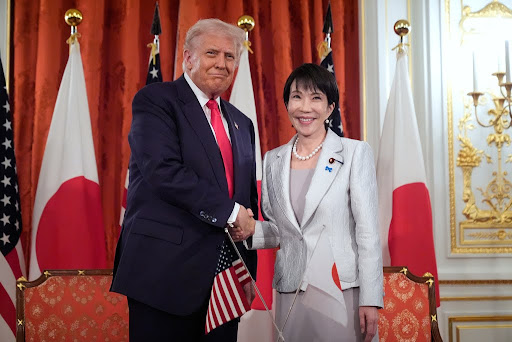
When Sanae Takaichi became Japan’s first female prime minister in October 2025, she wasted no time signaling her priorities. Within days of taking office, she flew to Washington, D.C. to meet U.S. President Donald Trump to form a Technology Prosperity Deal and establish a rare-earth and critical-minerals partnership. This suggests her intention to strengthen ties between the U.S. and Japan. She portrays herself as a nationalist: security-minded, unapologetically assertive, and a fan of the “Iron Maiden,” Margaret Thatcher. What does this mean for the future of the U.S.-Japan-China relationship?
Takaichi’s domestic agenda mirrors her mentor Shinzo Abe’s legacy. She has pledged a revival of Abenomics: ultra-low interest rates, expansive fiscal spending, and state-driven economic revitalization. But, unlike her predecessor, she couples this economic continuity with an aggressive defense agenda. Her premiership is expected to move Japan further to the right, responding to a recent populist wave that bears some similarities to President Trump’s MAGA movement. She has pushed the message that “Japan is back,” embraced hawkish policies on China, and downplayed Japan’s atrocities during World War II. As a vocal critic of China’s military and economic expansion, Takaichi insists Japan must enhance its deterrence capabilities, increase defense spending to at least two percent of GDP, and deepen coordination with U.S. forces stationed in the Indo-Pacific.
Yet Takaichi’s nationalism carries diplomatic risks. Like Abe, she claims that Japan’s wartime atrocities have been “overstated.” Her regular visits to the Yasukuni Shrine, which honors Japan’s war dead — including Class-A war criminals — have long provoked outrage in China and South Korea. Such acts, while symbolic domestically, reinforce perceptions abroad that Japan remains unwilling to confront its imperial past. In fact, China often condemns Japanese officials for visiting the shrine. For Beijing, these acts serve as strong reminders of unresolved historical trauma and justify continued skepticism toward Japanese rearmament.
Still, diplomacy is not dead. On Oct. 31, 2025, Takaichi met China’s Chairman Xi Jinping in Gyeongju, South Korea. President Xi emphasized that China and Japan are neighbors separated only by “a narrow strip of water,” and that the long-term, healthy, and stable development of China-Japan relations meets the common expectations of the peoples of both countries and the international community. He also highlighted that China-Japan relations currently face both opportunities and challenges. China expressed hope that Japan’s new cabinet would “establish a correct understanding of China, cherish the dedication and efforts made by the older generation of politicians and people from all walks of life in both countries to develop China-Japan relations, and adhere to the broad direction of peace, friendship, and cooperation between the two countries.”
The U.S.-Japan-China triangle now revolves less around balance and more around tension. Tokyo’s pursuit of “national revival” aligns it with Washington’s containment strategy while deepening frictions with Beijing. Takaichi’s Japan has chosen to stand shoulder-to-shoulder with the U.S. and embraced an economic and security partnership that directly challenges Beijing. In doing so, Tokyo gains leverage but loses flexibility. Its deep integration with China’s economy — still Japan’s largest trading partner — means that complete alignment with the U.S. could backfire economically. Yet, soft-pedaling Beijing risks alienating Washington, especially under Trump’s renewed “America First” assertiveness.
If she fails, Japan may find itself trapped between its two most powerful neighbors: bound to Washington by ideology, and to Beijing by necessity. The future of this triangle will depend on whether Japan can reconcile its ambition for autonomy with its dependence on both the American security umbrella and Chinese markets. Takaichi’s challenge lies in maintaining that balance.
Will she succeed?
The Zeitgeist aims to publish ideas worth discussing. The views presented are solely those of the writer and do not necessarily reflect the views of the editorial board.