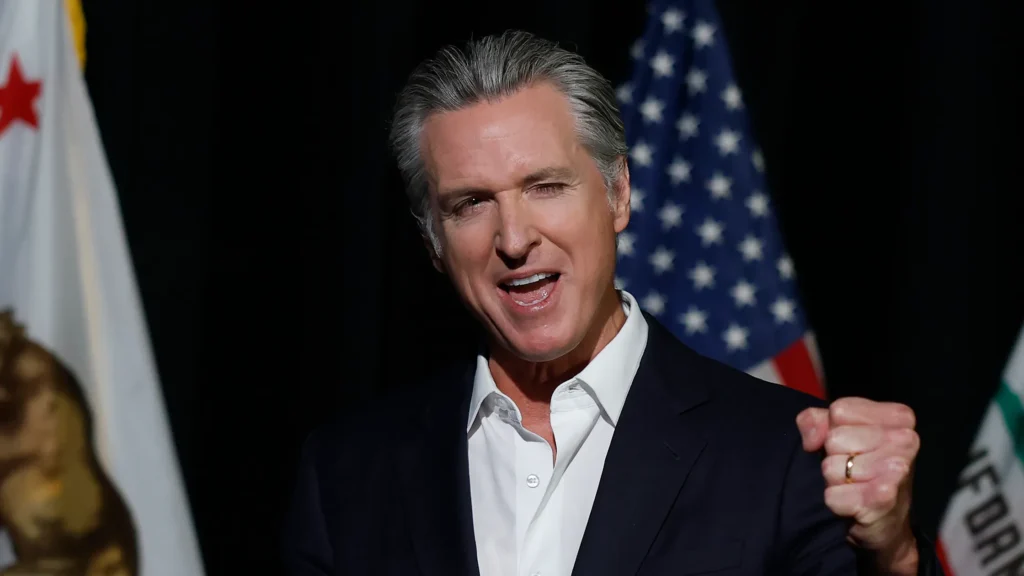
“Spare me the moral high ground at this particular moment in American history,” said California Governor Gavin Newsom during a press conference last week. Coming from a likely 2028 presidential candidate, that line cut against the Democratic mantra of “When they go low, we go high.”
We loved that line when Michelle Obama said it in 2016 — our decency as our defense. But nearly a decade later, that comfort has calcified into denial. The moral high ground has become an island: elevated, empty, and irrelevant.
Meanwhile, the right has rewritten the rules. Project 2025 lays out not a political platform but a blueprint for power — an organized, openly authoritarian plan to dismantle everything from the civil service to reproductive rights. And Democrats? We’re still giving speeches about bipartisanship, still scolding ourselves for being “too extreme,” and still pretending the rules are the same when they clearly aren’t.
However controversial Gov. Newsom may be, he’s one of the few Democrats willing to admit it is no longer 2015. This is not a fight for moral high ground; it’s a fight for survival.
Gov. Newsom has built a reputation on confrontation. He’s taken up the role of Trump’s most persistent antagonist, mocking him on social media, baiting him with satire, and challenging his authority at every turn — from refusing to deploy the California National Guard to standing up to federal immigration raids. He’s brash, theatrical, and sometimes exhausting. But he understands something his party too often forgets: visibility is power.
His record is far from admirable. He’s alienated progressives with his crackdown on homeless encampments and angered the left with his stance on transgender athletes. None of that disappears because he’s loud about Trump. However, when so many Democrats are hesitating, he’s one of the few managing to meet Republican offensives with equal force.
That is most visible in Proposition 50, his latest contentious play. After Trump and GOP legislatures pushed aggressive gerrymanders in states like Texas, Missouri, and North Carolina, Newsom responded with a counteroffensive. Proposition 50 would redraw several California districts in Democrats’ favor, effectively neutralizing some of the Republican gains.
The idea of fighting gerrymandering with more gerrymandering makes people uneasy — and it should. The process itself is undemocratic. It creates skewed, unrepresentative maps where electoral outcomes are virtually guaranteed, and lets politicians choose voters instead of the other way around. Critics argue Democrats should take the high road and “un-gerrymander” blue states like Illinois to set an example, so that voters will recognize the principle and thus support Democrats. But that assumes their votes will count. They won’t. When one side rewrites the boundaries and the other refuses to respond, the outcome isn’t virtue — it’s surrender.
There’s always a moral question in politics; what you stand for always matters. But there are moments when survival comes first — when protecting the system itself has to precede perfect alignment within it. The current threat to democracy isn’t the coarsening of language or the loss of decorum — it’s the decay of accountability. Trumpism isn’t defined by insults on Twitter in all caps: it’s defined by the normalization of power without consequence. The fight for democracy isn’t about restoring civility. It’s about restoring capacity.

President Donald Trump and Gov. Gavin Newsom at Los Angeles International Airport.Photo by Mark Schiefelbein, AP Photo
There’s no perfect way to defend a system already breaking apart. But history makes one thing clear: doing nothing costs more than doing something imperfect.
In 1936, when Hitler re-entered the Rhineland in violation of the Treaty of Versailles, Britain and France did nothing. They told themselves they were preserving peace when, in reality, they were surrendering it. Appeasement wasn’t diplomacy — it was paralysis disguised as principle.
A century earlier, the United States made the same mistake. After the Civil War, President Andrew Johnson preached unity over justice, pardoned Confederate leaders, and allowed them to write the Black Codes — undoing the promise of Reconstruction. His moral restraint became a moral failure, and the consequences lasted a century.
By contrast, Abraham Lincoln understood the paradox at the heart of democratic defense: sometimes, preserving freedom means temporarily bending the rules that protect it. He suspended habeas corpus, expanded executive power, and censored pro-Confederate newspapers — not to destroy the Constitution, but to save it. The difference is intent — he wasn’t undermining democracy for personal gain; he was stretching its limits to preserve its core. Fighting hard doesn’t have to mean fighting without ethics.
That’s the distinction Democrats keep missing. The question isn’t whether fighting back makes them “Trumpian.” It’s whether refusing to fight at all makes them obsolete.
Look around. Congress is paralyzed. The courts are partisan. The president is openly testing the limits of the Constitution in pursuit of a third term. Each week tests how much chaos the system can take before it fractures. And through it all, Democrats still talk about “tone,” as if democracy will thank them for good manners on its deathbed.
Newsom’s tactics make people uncomfortable, but discomfort isn’t corruption — it’s adaptation. He’s experimenting with a political language that matches the urgency of the moment. That doesn’t make him admirable: it makes him realistic.
Defending democracy will never be clean work. It wasn’t for Lincoln. It wasn’t for the suffragists or the civil rights activists who broke unjust laws to make better ones. It won’t be for us. But “going high” doesn’t mean staying above the fight — it means knowing what you’re fighting for, and why it matters enough to get dirty. It isn’t about abandoning morals — it’s about having the conviction to do difficult, often uncomfortable things in order to protect them. The moral high ground only matters if there’s still ground left to stand on.
The Zeitgeist aims to publish ideas worth discussing. The views presented are solely those of the writer and do not necessarily reflect the views of the editorial board.