
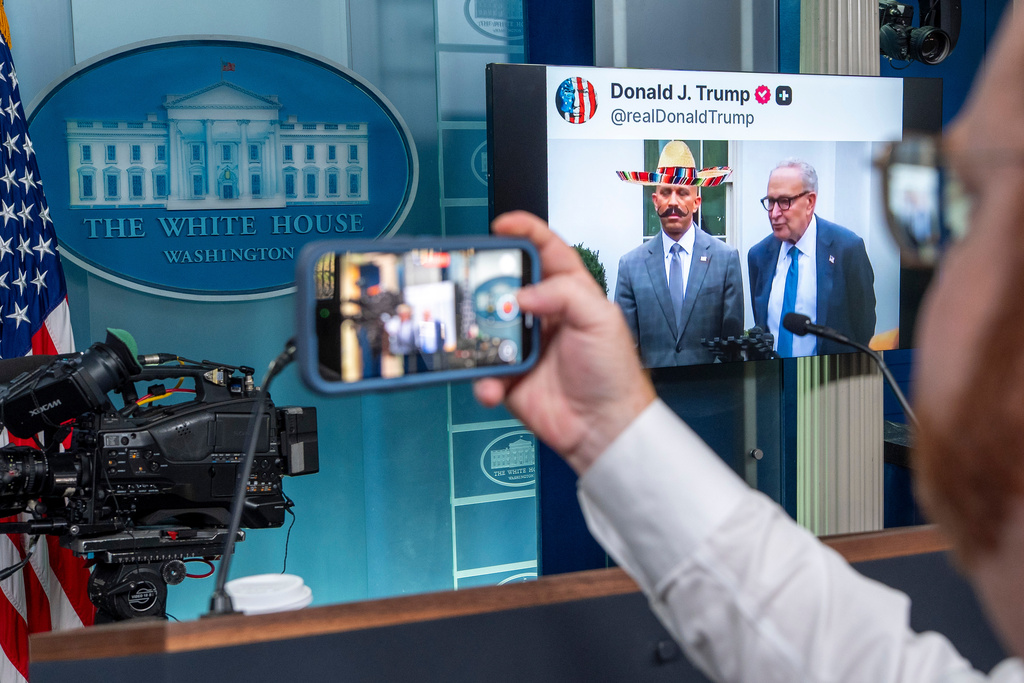
House Minority Leader Hakeem Jeffries, donning a sombrero and a handlebar mustache, stands alongside Senate Minority Leader Chuck Schumer, who remarks that “nobody likes Democrats anymore.” This scene did not really happen — it comes from an AI deepfake video Trump posted after the top Democrats tried to negotiate with him to avoid a government shutdown.
For Trump, social media has proven reliable at generating press and riling up his base time and again. Its role in his communications strategy is ever-expanding, compelling him to launch his own platform Truth Social in 2022 and court influencers during his 2024 campaign. Since inauguration, Trump has begun to embrace AI as a vital part of his messaging, with official POTUS, White House and DHS accounts increasingly posting deepfakes.
As official government accounts post synthetic images and deepfake political ads proliferate on Facebook, the concern that AI will exacerbate the epidemic of political misinformation is becoming reality. Yet Trump posting AI content doesn’t feel all that shocking, because America has become accustomed to his habit of falsifying, hyperbolizing and bending reality.
Trump’s AI posts underscore another hallmark of his messaging — just consider some of his signature rhetorical moves: hurling insults at opponents; firing off posts packed with capitalization and exclamation marks; peppering speeches with graphic descriptions of violence. By flouting professionalism, Trump distinguishes himself from the stereotypical overly-scripted politician and embodies his supporter’s anti-establishment sentiment. This uncensored and blunt language erodes his audience’s perception of a barrier between themselves and the man in the country’s highest office.
Trump’s AI posts further emphasize this dynamic: a CHAT-GPTed image of yourself as the Pope seems like something you’d send in a group chat with friends, not something the President of the United States would post on the official White House Twitter. That’s exactly why this schtick works. With every raving Tweet and AI meme, Trump’s supporters are made to feel even more a part of his in-group and reminded that articulate, professional politicians are the out-group, the “leftist elite.” Given that most of Trump’s statements can be boiled down to a message of “us versus them,” these AI posts help him drive that point home.
What Trump’s supporters don’t realize is that Trump has never thought of himself as part of their “us.” He doesn’t take an unfiltered approach because he sees his base as equals, but because he sees them as undeserving of greater professionalism or respect.
“I used to use the word incompetent. Now I just [say] stupid,” Trump told supporters in a 2015 campaign speech. Granted, Trump may not be a naturally intelligent or gifted communicator, but he doesn’t think he needs to be. He’s developed a communication style that relies on simple language and unsupported claims, suggesting he’s not worried his supporters would attempt to seek out more sophisticated, factual, nuanced information elsewhere. Trump’s style therefore implies a belief that his supporters lack a certain level of intelligence. By communicating through animated images that are so unserious it’s comical, Trump’s AI posts go to the extreme of infantilizing his supporters. Perhaps America elected a ridiculous, unsophisticated man who just loves AI memes. Or perhaps America elected a man who gets a kick out of feeding his supporters asinine content on social media and soaking in the attention it gets him. As the President said himself, “I don’t care about you. I just want your vote.”
The Zeitgeist aims to publish ideas worth discussing. The views presented are solely those of the writer and do not necessarily reflect the views of the editorial board.