On Saturday, Oct. 18, nearly seven million protesters marched in solidarity at what is now being considered the largest single-day demonstration in U.S. history — the second nationwide No Kings protest. Brought together by a shared disapproval of President Trump’s bold presidential actions and disregard for civil liberties, these outraged Americans shut down busy streets across thousands of U.S. cities and towns to rally in defiance. But for all the publicity it received, the record-breaking numbers it attracted, and the peaceful nature it displayed, No Kings proved to be more symbolic than substantive. This reflects a growing pattern where contemporary protest movements have had little tangible effect on Congressional legislation or executive policy.
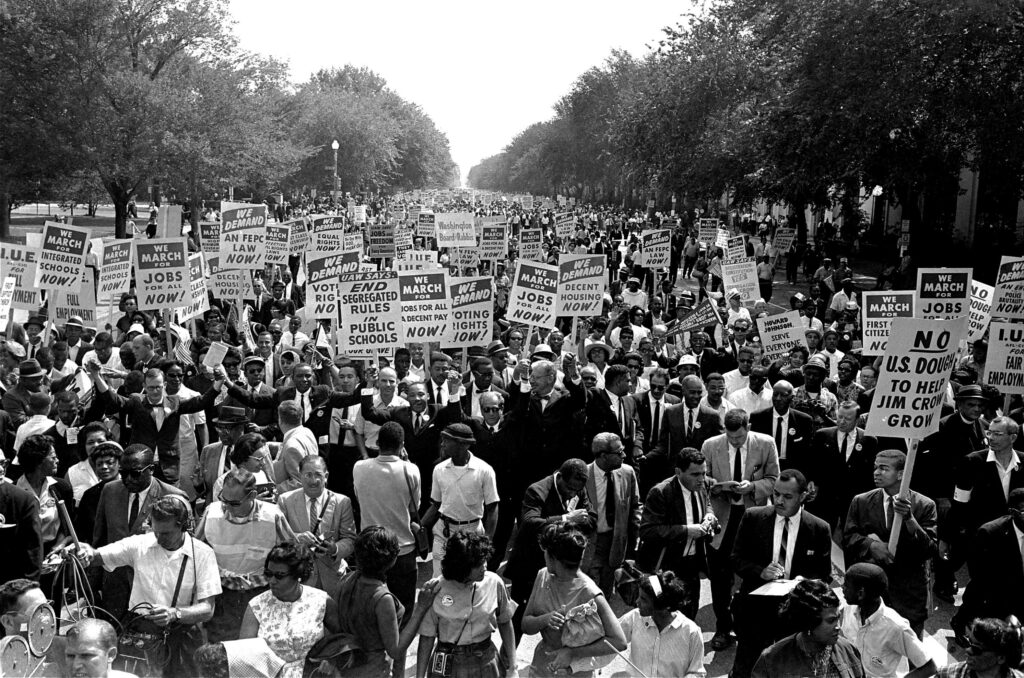
Large protest demonstrations in America once served as the driving force behind transformative change and directly altered the nation’s course. Most famously, the Civil Rights Movement of the 1950s and 1960s combined civil disobedience, constant street demonstrations, and precise political communication to pressure lawmakers to take action. Central leadership, whether that be Dr. Martin Luther King Jr., Rosa Parks, John Lewis, Malcolm X, or so many other prominent figures, helped to steer the movement in an extremely effective manner, creating a unified message in which supporters and participants of the movement were well versed. In this case, every African American activist uniformly advocated for the end of racial segregation and discrimination, especially in housing, voting, and public facilities. As a result, Congress passed monumental legislation that directly addressed these goals and advanced the cause of racial equality as a whole. The Civil Rights Act of 1964, the Voting Rights Act of 1965, and the Fair Housing Act of 1968 all stand as proof that organized protests can have a powerful effect on governmental reform.
The anti-Vietnam War protests of the late 1960s and early 1970s, characterized by constant student demonstrations on college campuses, marches on D.C. and the Pentagon, and the notorious 1969 Moratorium to End the War in Vietnam, successfully shifted public opinion against U.S. involvement. Consequently, enormous pressure was put on government officials to consider military withdrawal. Despite reflecting a broader and more diverse movement than the Civil Rights Movement, there was still a coalition of influential figures and organizations shaping the anti-war actions and messaging such as Dr. King, Muhammad Ali, John Kerry, Students for a Democratic Society, and Vietnam Veterans Against the War. The effectiveness of the movement ultimately culminated with the final combat troops departing Vietnam in March 1973, demonstrating that political protest once had an undeniable impact not only on domestic policy but on foreign policy as well.
In contrast, No Kings and other modern-day demonstrations lack the fundamental elements that contributed to these successful protests.
For starters, an increasing percentage of attendees are alarmingly uneducated on the actual mission of the protest. University of California, Berkeley Professor Ron E. Hassner conducted a survey that polled 250 students from a variety of backgrounds across the U.S., asking which river and which sea is being referenced in the popular pro-Palestinian slogan often shouted at protests. Although over half of the students reported their support for the chant, only 47 percent of the supporters could correctly identify the Jordan River and the Mediterranean Sea. Then, when asked in which decade Israelis and Palestinians signed the Oslo Accords, “more than a quarter of the chant’s supporters claimed that no such peace agreements had ever been signed.”
Additionally, what seems to be severely lacking from contemporary protest movements is central leadership. Very few protesters today are even aware of who is behind the organizational effort, especially considering that No Kings had “more than 200 national organizations and thousands of local groups” as part of the planning and execution process. Although this reflects the extensiveness of the movement, it also creates discrepancies in the messaging depending on the region and protesters’ demographics. Those residing in a major city, such as New York, shared grievances of issues pertaining to ICE raids and federal funding cuts while those who marched in more rural areas focused on tariffs and escalating trade wars impacting their local economies. This disunites and disconnects the entirety of the coalition as different groups of people have distinctly different issues they prioritized.
While No Kings participants have a constitutional right to protest against an administration they thoroughly disagree with, the movement does not seem to be focused on attracting non-liberals or minorities. A survey conducted at the second No Kings demonstration in Washington D.C. found that “nearly 90% of participants identified with the political left,” and that “86% of surveyed protesters … were white.” Considering that the overwhelming majority of protesters likely hadn’t voted for Trump in the 2024 election and that a significant portion of the Republican base wasn’t present, it gives President Trump even less reason to consider the No Kings protests when engaging in future policymaking.
Even the title of the event, referring to President Trump as a “king,” is quite ironic considering a protest against a king wouldn’t even be possible in most countries. Real kings and autocrats certainly would never permit millions of their own people to challenge their decision-making and authority in such a public manner without severe consequences. Under King George III, for instance, the British government punished colonialists for protests like the Boston Tea Party with the Intolerable Acts of 1774, which shut down assemblies, replaced elected officials with crown-appointed authorities, and closed Boston Harbor. Yet, both of the No Kings demonstrations encountered no physical resistance or interference from the government.
Whether anti-Trump protesters realize it or not, they seem to be protesting the absolute epitome of American democracy. President Trump, over the past nine months, has been thoroughly enacting the very agenda on which he ran his campaign, resulting in an Electoral College and popular vote victory. Mass deportations, executive orders, tariffs, federal layoffs, and retribution were all policies Trump consistently pledged to implement as president. And now that he is doing exactly that with explicit approval from the Supreme Court in many instances, protesters call him a “king”?
A message for all future protesters: before stepping into the streets, understand the cause. Know the case. March with purpose, not just passion, and follow the example of those whose conviction created lasting change.
The Zeitgeist aims to publish ideas worth discussing. The views presented are solely those of the writer and do not necessarily reflect the views of the editorial board.