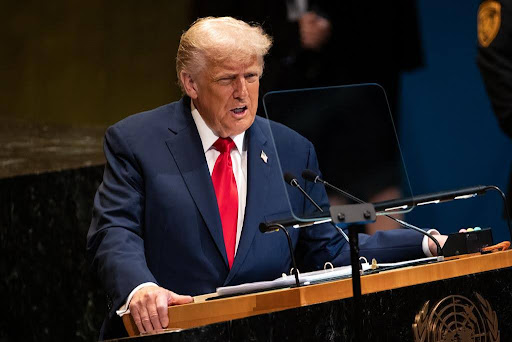
Sept. 23, 2025, at U.N. headquarters. (AP Photo/Angelina Katsanis)
The U.S. veto power, a relic of the post-WWII geopolitical order, allowed it to unilaterally block a ceasefire measure that had broad international support. While the veto is legally valid, does legality necessarily imply justice?
On Sept. 18, the United States stood alone among permanent members of the U.N. Security Council in vetoing a resolution calling for an immediate, unconditional, and permanent ceasefire in the Gaza Strip. Only three days later, on Sept. 21, the U.K., Canada, Portugal, and Australia announced their recognition and support for Palestine. On Sept. 22, France formally recognized Palestine as a state and called for an international peacekeeping mission at the U.N. The following day, Donald Trump addressed the U.N. General Assembly, accusing countries that recognized Palestine of encouraging terrorism and undermining peace. This rapid sequence of events exposed a growing rift in global diplomacy between traditional Western allies — nations once united by shared democratic values but now divided over how to resolve the Israeli-Palestinian conflict.
This was the sixth time the U.S. had cast a veto in the Security Council over the nearly two-year Israeli-Palestinian war. Representative Morgan Ortagus emphasized that Washington’s opposition to the resolution “will come as no surprise” as it fails to condemn Hamas or recognize Israel’s right to defend itself.
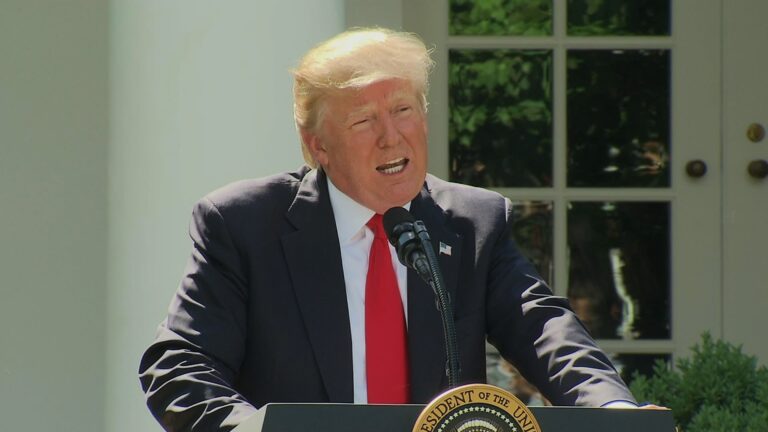
Furthermore, she argued that the text “wrongly legitimizes the false narratives benefiting Hamas, which have sadly found currency in this Council.” She added, “This resolution also refuses to acknowledge and seeks to return to a failed system that has allowed Hamas to enrich and strengthen itself at the expense of civilians in need.” Similarly, Trump’s speech on Sept. 23 dismissed France’s recognition, claiming that countries were “rewarding Hamas” and “undermining negotiations.”
On Oct. 7, 2023, Hamas attacked southern Israel, killing about 1,200 people and taking 251 hostages. In response, Israel launched a military campaign in Gaza. According to Gaza’s health ministry, at least 65,141 people have been killed in Israeli attacks since then, and another 435 people have died from malnutrition and starvation.
Many U.S. allies have stepped away from their alignment with the United States. The U.S. remains the only permanent member of the UNSC to not recognize Palestine. Trump’s speech reflects the broader U.S. narrative that equates strength with moral correctness, as though power alone justifies the decisions made in its name. This raises a crucial question: Who truly holds the authority to define justice in the international arena? If legitimacy lies only in the hands of the most powerful, then institutions like the U.N. risk becoming tools of domination rather than vehicles of peace. Undoubtedly, the United States still holds major power and influence over the world. But true justice cannot be defined by power alone; it must be built upon consensus, humanity, and the recognition of universal rights. The U.S. did not defend peace but undermined it by opposing even a humanitarian ceasefire.
The U.S. veto highlights a fundamental flaw in the UN system: it enables single nations to override the will of the many, now at the expense of human life and international consensus.
The Zeitgeist aims to publish ideas worth discussing. The views presented are solely those of the writer and do not necessarily reflect the views of the editorial board.