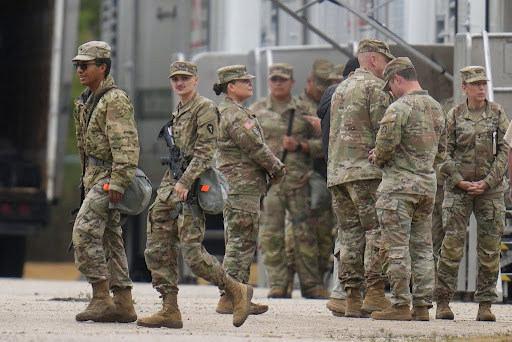
Earlier this month, Defense Secretary Pete Hegseth deployed 300 members of the Illinois National Guard and 200 members of the Texas National Guard to Chicago. In an official memorandum, U.S. Attorney General Pam Bondi wrote that use of the National Guard was necessary to stop “violent groups intent on obstructing Federal law enforcement activities,” such as those conducted by Immigration and Customs Enforcement (ICE). The National Guard is also supposed to aid in curtailing crime (President Trump has previously called Chicago the “murder capital of the world,” despite the homicide rate declining this year, following a general trend across the U.S.). National Guard mobilization has been prominent throughout President Trump’s second term, occurring in predominantly Democratic cities like Portland, Memphis, Washington, D.C., and Los Angeles. Most local governments, however, have not welcomed the troops. Underneath the rhetoric of “law and order” lies a steady erosion of federalism as states’ military powers become instruments for partisan power.
The National Guard is a section of the American military that uniquely possesses both state and federal responsibilities. It responds to domestic crises, such as natural disasters and civil unrest, while also supporting military operations overseas, including those in Ukraine and the Middle East. Generally, state National Guards are commanded by the governors of their respective states, but the president can federalize the guard in some circumstances.
Precedents have shown presidents rarely federalize a state’s guard without the consent of the governor, but President Trump is changing that. When Trump invoked Title 10 — which allows the president to federalize state Guard troops during foreign invasions — to send 4,000 troops to Los Angeles in June 2025, despite Governor Gavin Newsom’s objections, it was the first time in sixty years that a president had done so without a governor’s consent.
By ignoring the precedent of mutual agreement, the Trump administration is not simply testing the limits of its authority through an abuse of power. Rather, the Trump administration is slowly hacking away at the framework that keeps our country intact. Federalism is a form of government where power is shared between the central government and state governments, which both have distinct and concurrent powers; it is the reason why we have separate branches and checks and balances. This system has been present since our country’s birth, serving as a rationale for the Constitution’s ratification. In Federalist 39, James Madison wrote that “the proposed government cannot be deemed a national one, since its jurisdiction extends to certain enumerated objects only, and leaves to several states a residuary and inviolable sovereignty.” In cases where both the federal government and state governments have jurisdiction, federal management is supposed to be supplemental so as not to override states’ rights to self-rule. The 1878 Posse Comitatus Act further prohibits the use of the military for domestic policing.
As of now, the courts seem to understand this. The federal appeals court has ruled that Trump cannot deploy the National Guard in Illinois after officials in Illinois and Chicago sued the administration, saying the deployment is a “grave intrusion on Illinois’ sovereignty.” This order has been upheld by an appeals court, which wrote that “the facts do not justify the president’s action in Illinois… even giving substantial deference to his assertions.”
U.S. District Court Judge April Perry — who had issued the initial Oct. 9 order blocking the “federalization and deployment” of the National Guard to Chicago — also raised concerns over partisan biases. In the ruling, she writes that “although this Court was not asked to make any such finding, it does note a troubling trend of Defendants’ declarants equating protests with riots and a lack of appreciation for the wide spectrum that exists between citizens who are observing, questioning, and criticizing their government, and those who are obstructing, assaulting, or doing violence…[indicating] to the Court both bias and a lack of objectivity.” Perry accurately observes the Trump administration’s intolerance for opposing viewpoints, seen in the broader pattern of disproportionately targeted troop deployments in Democratic-led cities protesting his policies. President Trump has also proposed sending troops to cities such as New Orleans, New York City, Baltimore, San Francisco, Oakland, and St. Louis. Unsurprisingly, these are also all democratic-led cities.
Even if it were simply about reducing crime rates — which are already decreasing — research has found that military policing rarely does better than traditional police in crime reduction. Even in cases where crime declines in the short term while military forces are present, rates often rise again after those forces leave. The National Guard, therefore, may not be able to produce the intended effects on crime rates that the Trump administration expects and uses as justification.
The use of the National Guard in this manner is a warning sign for American democracy. When federal power is used to punish political opposition — as National Guard deployment solely in democratic-led cities exemplifies — it erodes the federalist system of government that the framers designed to prevent tyranny. Mutual respect between different branches of government and political parties is a prerequisite for our country’s functioning. As polarization worsens, this threat to federalism may become more imminent. Preserving the fragile balance between state and federal authority is not a partisan concern, but a constitutional necessity.
The Zeitgeist aims to publish ideas worth discussing. The views presented are solely those of the writer and do not necessarily reflect the views of the editorial board.