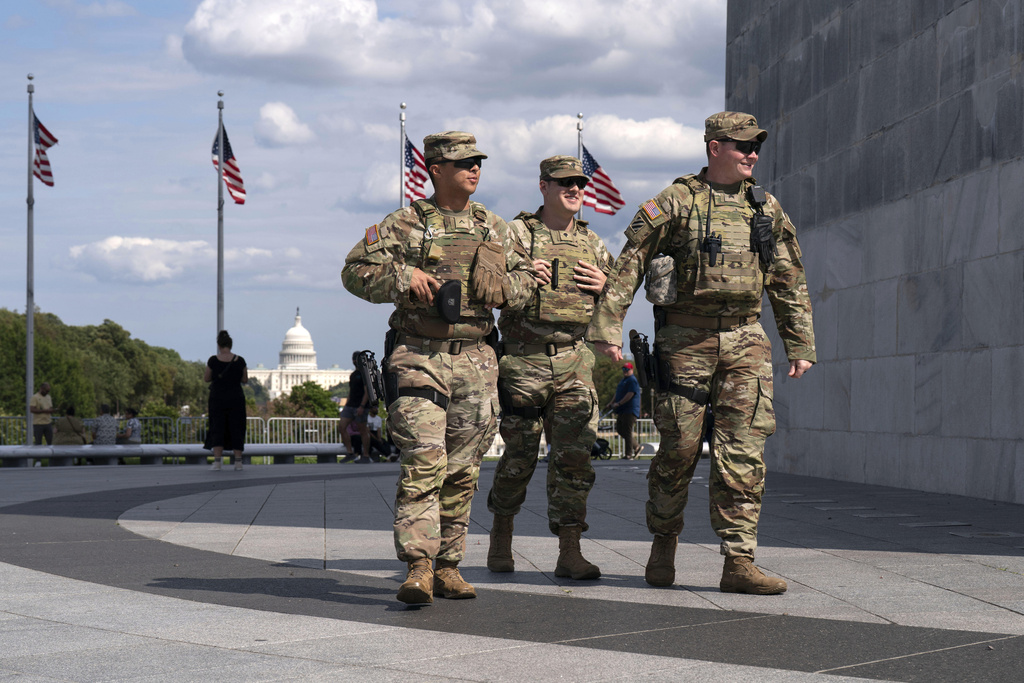
Big things are brewing in America’s judiciary. The Supreme Court will soon rule on the use of the National Guard as part of the Trump Administration’s ongoing incursion on American cities. For months, Trump has deployed the National Guard and other forces in a seemingly ever-changing list of Democratic-run cities: Los Angeles, D.C., Memphis, Chicago, and now, possibly Portland. Various threats have been levied at other cities and then walked back.
The legal response to these deployments has been convoluted, to say the least.
During the Guard’s stay in Los Angeles in June, District Judge Charles Breyer ruled that Trump must return control of the California National Guard to the state. The Ninth Circuit Court of Appeals ultimately granted a stay of Breyer’s ruling, allowing Trump to retain control of the Guard in California.
In Illinois, legal battles have produced a different outcome. District Judge April Perry issued an order that indefinitely blocks mobilization of the National Guard in the Chicago area pending the administration’s appeal to the Supreme Court. So far, the Court has been fairly silent on this issue and allowed lower courts’ rulings to stand; no matter the outcome, its impending decision on the National Guard in Illinois is certain to be groundbreaking.
But the administration’s plans seem to be far grander than its current actions — and therefore, beyond what the Court is deciding on. Secretary of Defense Pete Hegseth was asked last week about an unverified leaked memo calling for “the establishment of a National Guard response force that will be trained in crowd control and civil unrest deployed in all 50 states by April of 2026.” Instead of denying the memo’s authenticity, Hegseth responded: “I’m not gonna answer particulars on something that may be in the planning process.”
Regardless of the memo’s genuineness, the Trump administration has certainly embarked on an unprecedented expansion of presidential power. Since World War II, the President has only mobilized the National Guard ten times. These current deployments are the first since 1965 — when President Johnson sent the Guard to protect civil rights marchers — not consented to by the occupied states’ governors. The current operation is also, arguably, the first ever presidential use of the Guard in response to peaceful protests — a perspective that flies in the face of the Constitution, which authorizes the President to call up the Militia solely “to execute the Laws of the Union, suppress Insurrections and repel Invasions.”
A Supreme Court ruling in Trump’s favor would open the door to unchecked executive power through military force — the likes of which the United States has rarely seen before. On the other hand, a ruling against Trump would not necessarily preclude him from using the Guard as Hegseth’s comment suggests.
In other words, Trump could defy an unfavorable Supreme Court ruling because the Court lacks direct powers to enforce its rulings. By controlling the military and Congress, there is little stopping Trump — physically or financially — from ignoring a Court order. And so far, Trump has openly defied lower court orders without any serious consequences or hurdles. One analysis even found that the administration has defied one-third of all court orders against it — that’s 165 cases as of July.
Defying the nation’s highest court could yield far worse political consequences for Trump than ignoring lower courts. But, the extent of that consequence would ultimately be decided by Democratic governors.
State-level Democratic leaders need to carefully consider if and how they should respond to Trump if he violates a Supreme Court ruling. Taking action beyond mere words could potentially escalate the situation into violence, but doing nothing in response would allow Trump to further seize power, trample the rule of law, and erode our system of government.
To enforce a ruling themselves, states would need to sanction military officials who act in violation of the Court. Some Democrats, including Illinois Gov. J.B. Pritzker, have discussed prosecuting Immigration and Customs Enforcement (ICE) agents. Prosecuting an illegal, large-scale National Guard deployment, however, would be a logistical and political nightmare. How could a state prosecute an invasion? The partisan loyalties of local law enforcement would certainly make this difficult.
Governors potentially making these decisions must evaluate their own ability to counteract federal overreach through their state’s law enforcement agencies. If local law enforcement in Los Angeles is more loyal to Trump than California Gov. Gavin Newsom, the state would have minimal leverage to prevent Trump from breaking the law once democratic norms are thrown out. Without the ability to actually enforce the Court’s ruling themselves, states are left powerless.
The ultimate decision — of whether or not to take action against a defiant Trump administration — must come down to relationships between Democratic elected officials and law enforcement. Governors and mayors who do not yield the political sway to impede Trump’s operation should not make matters worse by attempting to intervene. Those who do, however, must take action instead of sitting idly by while American democracy crumbles.
The Zeitgeist aims to publish ideas worth discussing. The views presented are solely those of the writer and do not necessarily reflect the views of the editorial board.