It was an unsurprising turnout last Saturday — even Ted Cruz admitted it!
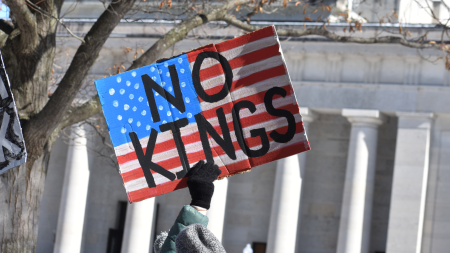
About six million people participated in the second run of No Kings protests, which themselves consisted of 2,700 affiliated events occurring both within and outside the United States. The protest’s aim, from top down, was to show resolve among the American people against the increasingly hard authoritarian lean that the Trump’s administration’s been on. Key topics of contention are Trump’s defunding of educational institutions, illegal gerrymandering, the influence of technocrat-billionaires, and the ICE raids in which masked agents “round up” illegal migrants to expedite their deportation process. Trump has also made several — some successful — attempts to bring states’ National Guards under his authority in order to militarize the “crime-ridden” cities on the Northeast and West Coasts, and Chicago too: all the major cities under Democratic mayoralship.
We’re certainly not without our reasons to protest right now! And so, last Saturday, I took the R-train up to the Morningside Heights event, the smaller and perhaps the more individualized of the two No Kings events in Manhattan, to see how these protests were shaping up and to ask attendees what exactly it was they were feeling. What I found was hopeful, but with mixed sentiments.
Everyone with whom I spoke agreed on the basics: The American people have to stand up to Trump. In that, everyone also agreed that the purpose of these No Kings protests should be to show resolve in the sense that the Trump administration should be made aware, very visibly, of the community. This is all in accordance with the protest framework laid out by national organizers.
Where people disagreed, however, was on a specific purpose. Or, in other words, on what the protest should even be.
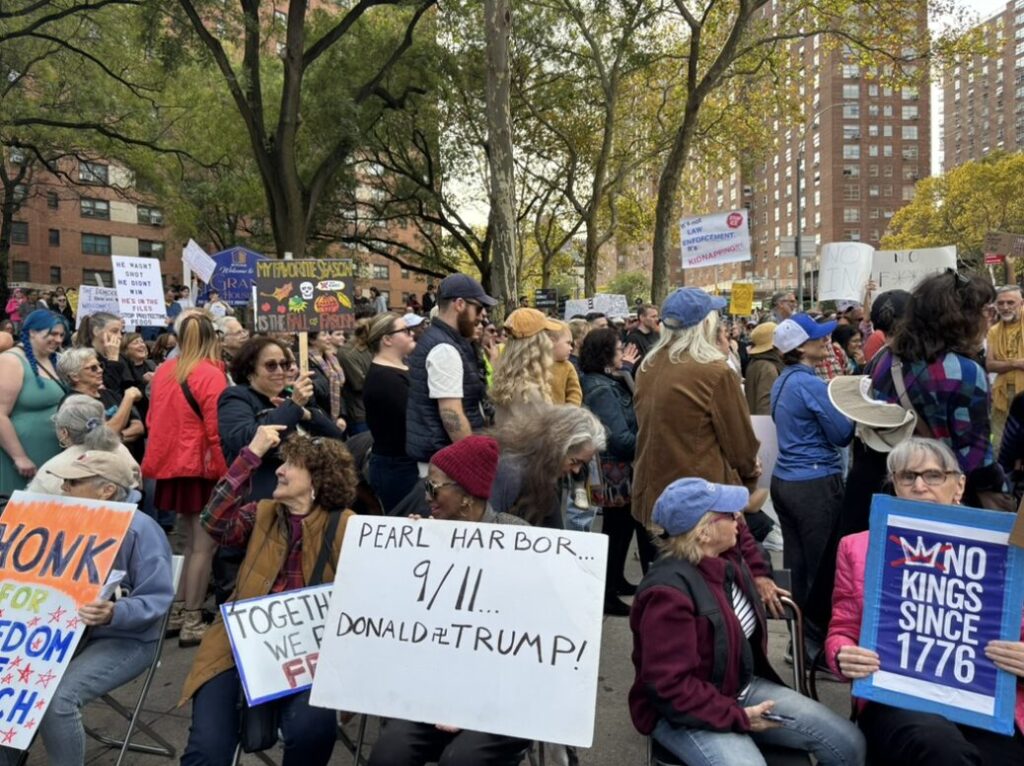
Todd Davis, CEO of the Harlem Wizards basketball team, told me that this event was about individuals coming together to stave off depression. It’s about not feeling powerless, he argued. He also called for the specific action item of unmasking ICE agents. Similarly, Dr. Michele Sweeting-DeCaro, an adjunct professor at CUNY and pastor at the People’s Church, said that the event was about bringing together the community. She, though, argued that the protest wasn’t so much a protest, but more of a rally. By her definition, rallies are celebrations of people and their voice. Protests, on the other hand, are about action, something which was lacking at the No Kings protest — using protest, for simplicity — in Morningside Heights. The event was fenced in on the corner of the park on West 125th and Amsterdam, and attendees mostly shuffled in place — very non-disruptive as far as protests go.
If the event was supposed to be more of a protest, then, by Dr. Sweeting’s definition (which I tend to agree with), it was rather tame. And, I’d argue that makes the protest less effective overall. If the event was supposed to be more of a rally, however, a celebration of community, there were awfully few community locals: the vast majority of the attendees were White, and a significant portion of those were retiree-aged.
These people had little entry risk and, thus, little stake. They often weren’t from the local area, and so they didn’t risk retribution from their neighbors. The area was ideologically aligned with No Kings, in fact; the supportive honks of passing drivers were non-stop. They also weren’t risking jobs or financial positions as many were either already retired or had their money tucked away safely. And, they weren’t racial minorities who, having spoken out against the Trump administration, have been the first targets of censorship and threats of arrest or deportation. They have relatively little to lose, essentially, and that too can explain why many locals didn’t turn out to protest: They’ve got a lot more on the line.
Speaking to Bridget Anthony, a lecturer at CUNY who attended last Saturday’s protest, she argued that the predominantly White crowd lacked the ethic to conduct a protest effectively.
“There’s no music. It’s not clearly organized,” she said. “No one has a bullhorn… typically, the people who are chanting have some sort of musical accompaniment. There’s not a whole lot going on.”
Anthony proceeded to explain how Black women have taken a step back from planning these protests and, as such, experiential knowledge is absent, knowledge which could otherwise improve the efficacy of No Kings.
Any step in the right direction is one which should be taken, she says, but “White people need to get a whole lot angrier. People need to begin to feel empathy [again].”
At any rate, I’ll say that the protest was a step in the right direction. (However impactful that step was remains to be seen.) If I were to suggest anything, then, however meaningful my suggestions may be, I’d advise organizers to reclassify No Kings events as rallies, which could refocus the objective on community solidarity and less so on “change-making.” If organizers want to embolden their efforts — and I suspect they do — then they need to take credible positions to avoid the faults of virtue signaling (and shed the label so often misapplied by dissenters.) To do this, protesters need to put more at stake. Now, what can be put at stake is situational — but otherwise, what’s the point? If increasing stake is too costly, a rally approach should be preferred. Either way, it shows resolve.
Ultimately, whatever we do, we just don’t want to be like Jerry Jones. Remember him? The Dallas Cowboys owner? If you follow sports, he’s probably a more front-of-mind figure, but three years ago, the story broke when an image resurfaced from the 1957 Little Rock protests showing a sophomore Jones standing off while his White classmates tried to prevent Black students from entering their high school. It wasn’t Jones’ responsibility to make that happen — apparently, he was just curious about the commotion — and few will fault him for not getting involved, but in hindsight, from a reference point as unconcerned with personal dilemmas as a photograph, it feels regretful that more wasn’t done. Today, we have the historical precedent and political intuition to know that if we don’t take action, it’ll also be regrettable. So, I say let’s not run a Jerry Jones — it’s best to avoid the grief altogether.
The Zeitgeist aims to publish ideas worth discussing. The views presented are solely those of the writer and do not necessarily reflect the views of the editorial board.