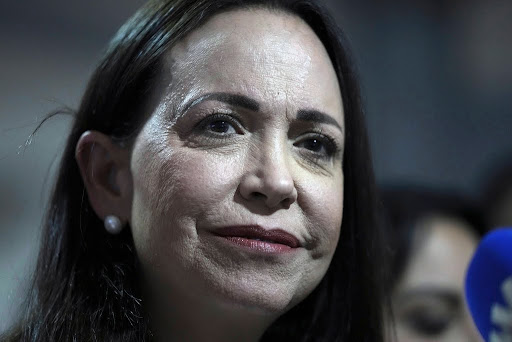
María Corina Machado won the Nobel Peace Prize on Oct. 10th, 2025 for “[keeping] the flame of democracy burning amidst a growing darkness,” sparking criticism from many across multiple media outlets and global regions. Though there are valid reasons why the Norwegian Nobel Committee sees Machado as a leader of the opposition to the Maduro dictatorship, having been expelled from the National Assembly in 2014 and barred from running in the 2024 Venezuelan presidential election, their selection raises important questions.
In response, Machado was quick to say that Donald Trump deserved to win the award and thanked him for his contribution to her cause, referring to the latest drug boat bombings and sanctions against the Venezuelan dictator, Nicolás Maduro. Machado’s premiation couldn’t have been more coincidental as U.S. foreign policy shifts back to South American oversight, with both the Biden and Trump administrations condemning violations of democracy in Venezuela.
Winning the Nobel Peace Prize provides political figures with legitimacy and ties a global audience closer to desired moral values. Laureates like Nelson Mandela and Malala Yousafzai undoubtedly deserve the prize for bravely fighting for meaningful causes like the end of apartheid in South Africa or the right to education, however, when figures like Kissinger or Obama win, the award criteria is closer to being defined by political reasons than by efforts of achieving global peace.
Kissinger’s victory in 1973 for having negotiated a ceasefire in the Vietnam conflict is one of the most controversial to date, simply because Kissinger was a warmonger responsible for the carpet-bombing of Cambodia from 1969 to 1973 and South American coups d’état. Obama’s 2009 award is controversial because he was awarded the prize nine months into his presidency, while the United States still carried out military operations in Iraq and Afghanistan. Understanding that Nobel Prize statutes do not allow for a prize to be revoked, critics of Obama or Kissinger often overlook the prize statutes or the fact that the awards preceded the actions they cite, like drone strikes or the East Timor genocide.
Lê Đức Thọ, a Vietnamese diplomat and co-recipient of the 1973 Nobel Peace Prize with Kissinger, rejected the award, stating that true peace had not been achieved. Perhaps the Norwegian Nobel Committee does not concern itself with results, and rather awards participation trophies.
According to the Norwegian Nobel Committee criteria for the Nobel Peace Prize nomination process, cabinet members and ministers of sovereign states and current heads of state may submit a nomination for the Nobel Peace Prize, thus allowing foreign policy interests to sway the decision.
Secretary of State Marco Rubio nominated Machado for this year’s prize in 2024 while he was still a senator and a senior member of the Senate Foreign Relations Committee and the Vice Chairman of the Senate Select Committee on Intelligence. This nomination, combined with Kissinger’s and Obama’s past awards, and recent U.S.-Venezuela hostility, suggests a long-standing relationship between the Norwegian Nobel Committee and U.S. Foreign Policy leadership. What further proves this relationship is that Speaker Mike Johnson (R-LA) said that he will work with Israeli Knesset Speaker Amir Ohana to rally international support for Donald Trump’s 2026 Nobel Peace Prize nomination.
While Johnson’s announcement comes after the Trump-brokered ceasefire in Gaza and negotiations in the Russia-Ukraine war, the announcement raises questions of whether the United States and Israel will exchange political favors for Nobel Peace Prize nominations.
The Zeitgeist aims to publish ideas worth discussing. The views presented are solely those of the writer and do not necessarily reflect the views of the editorial board.