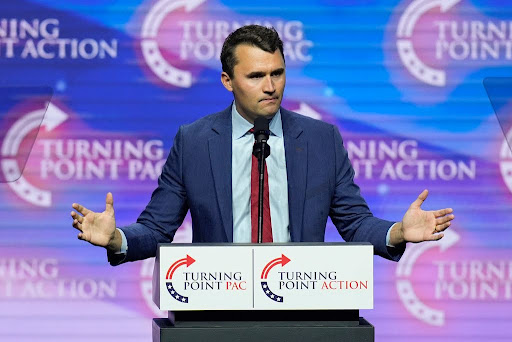
In a recent episode of the “Ezra Klein Show,” Ezra Klein had on writer Ta-Nehisi Coates to talk about their differing responses to the assassination of Charlie Kirk. Coates had written a piece for Vanity Fair criticizing prominent liberals, including Klein, who responded to the incident. These puff pieces hailed Kirk as a master of debate and a shining example of how politics should be conducted. They lauded Kirk in death, but ignored how he lived.
Coates rightfully called this out in his piece, detailing Kirk’s politics of hate and dehumanization. He drew a line in the sand, a point at which “spirited debate” is no longer possible. When the person on the other side of the table does not see you as human, there is no conversation to be had.
Kirk did not engage in debate with an open mind as a practice of the American principle of free speech — he toured college campuses across the country, preying on unprepared 18-year-olds with tired talking points and verbal badgering. Coates gives specific examples of things that Kirk has said, including quotes like “prowling Blacks go around for fun to go target white people” and “the philosophical foundation of anti-whiteness has been largely financed by Jewish donors in the country.”
It’s telling that Klein’s piece included no such quotes or even any words from Charlie Kirk at all. His actual rhetoric is completely excluded from the article, with focus instead being placed on empty platitudes and calls for peace. Kirk was not a man of peace. In fact, he advocated for the very violence that caused his death.
One week after the mass shooting at the Christian Covenant School in Nashville, Tennessee, in 2023, took the lives of three children and three adults, Kirk said at a public event, “I think it’s worth it to have a cost of, unfortunately, some gun deaths every single year so that we can have the Second Amendment to protect our other God-given rights.”
I think the murder of Charlie Kirk was wrong. It is just another example of the rising political violence in this country, and it makes it more dangerous for everyone, left or right, to exercise their right to free speech. Political commentators across the spectrum are afraid to appear in public spaces and are forced to reconsider the security measures they have in place. But to say that Kirk was “practicing politics in exactly the right way,” as Klein does, is to be willfully ignorant of the man’s words and his actions in the real world.
On Jan. 6th, 2021, Kirk bragged about sending 80 buses of people to the riots at the Capitol building. Is this the kind of “moxie and fearlessness” Klein praises in his piece? When he says he “envied what he built,” what does he mean? This is not journalism. At best, it’s misguided. At worst, it is the intentional whitewashing of a man who stood against nearly every single basic value that figures like Klein claim to uphold.
Coates rectifies this grave error by laying out exactly what Kirk contributed to: a culture of political violence that, in the end, took his life. Klein then invited him onto his show to have exactly the kind of spirited disagreement that he praised Kirk for.
At the very beginning of the episode, the first thing Coates does is praise Klein for being willing to have him on, saying that it isn’t easy to confront people who criticize your work. I agree with him, but unfortunately, it doesn’t seem like Klein really used this opportunity to further any understanding.
For the next hour, Klein buries his head in the sand, seemingly not understanding a single thing Coates is saying and peppering him with irrelevant questions and vague gestures toward unity.
There’s a moment toward the end of the episode where Coates talks about the regular violence, both systemic and individual, that marginalized communities face in an attempt to explain to Klein why this is not new or surprising. He goes into detail about his perspective as a Black man and how the struggles his community faces in America have given him a very different view of the country than someone like Klein. He gives real historical examples that inform his worldview and the way he thinks that we, as a society, should move forward.
Klein responds to all of this with a Buddhist meditation he likes about living with peace. He disarms Coates’s entire monologue with a simple deflection and resumes his asking of vague questions about “moving forward.”
It’s a very frustrating viewing experience, and I’m not the only one who thinks so. Nearly all of the comments on the episode praise Coates for his patience in talking to someone who is clearly not really interested in what he has to say.
As aggravating as it is, it isn’t surprising — the popular liberal opinion has always taken this form. Figures like Klein are committed to a politics of platitudes and hand-waving without actually standing for anything. They gesture towards the importance of hearing voices from marginalized communities, but refuse to listen when those voices say something they don’t understand.
When you’re someone like Ezra Klein, it is easy to look at a man like Charlie Kirk and ignore his words, focusing on the way he “practices politics” instead of the politics he actually practices. But if you are black, or an immigrant, or transgender, it isn’t so easy to look past. We do not have the luxury of debating people who don’t recognize our right to exist.
The Zeitgeist aims to publish ideas worth discussing. The views presented are solely those of the writer and do not necessarily reflect the views of the editorial board.