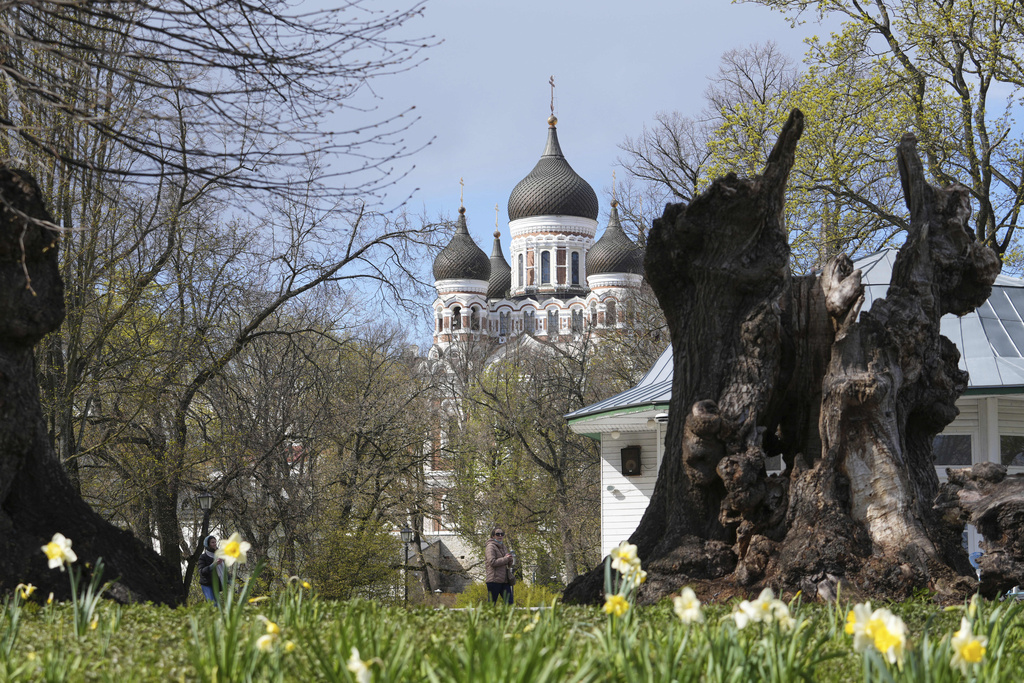
The Alexander Nevsky Cathedral, in Tallinn, the capital of Estonia. (AP Photo / Sergey Grits)
On April 9, 2025,the Estonian government enacted a statute compelling all religious entities to dissociate from foreign institutions that propagate violence or hatredwith a vote of 60-13. Officially named the “Law for the Prevention of the Instrumentalization of Religious Organizations to Incite Hatred or Violence,”this legislation addressesincreasingworriesabout foreign interference in Estonian religious institutions. According to its explanatory note, the law’s purpose is to maintain Estonia’s religious freedom by safeguarding the state and society from potential influences that could endanger national security, constitutional order, public order, or promote military aggression. As a result of this new legislation, the Estonian Orthodox Church is now required to sever its ties with the Moscow Patriarchate.
This decision by the Estonian government to order the Estonian Orthodox Church to cut ties with Moscow is not only justified but essential. It strategically ensures that Russian influence is curbed in Estonia and does not threaten Estonian security and sovereignty.
Thus, it is critical that the Estonian Orthodox Church of the Moscow Patriarchate, or MPEÕK, follows the decision of the government and cuts ties with Moscow Patriarchate — a move that the other main Eastern Orthodox church in Estonia, Estonian Apostolic Orthodox Church or EAÕK, has already adopted. One way it could accomplish this is by switching its patriarchate to fall under the Ecumenical Patriarchate of Constantinople while retaining their customs, language, calendar, and internal life. MPEÕK has the potential to achieve full independence by cutting its ties with Moscow, akin to the Orthodox Church of Latvia, which successfully severed its connections with the Moscow Patriarchate in 2022 which further diminished the Russian Orthodox Church’s influence.
These steps are necessary because the Russian Orthodox Church has evolved beyond being merely a religious institution. It has become a political instrument for Putin, who utilizes it to enhance Moscow’s influence in regions with significant Orthodox populations. Since the onset of Russia’s full-scale war against Ukraine, the Russian Orthodox Church has played an active role in supporting the Russian war effort. The patriarch and clergy not only echo the central themes of Kremlin propaganda but also contribute to their development. Patriarch Kirill, the leader of the Moscow Patriarchate, has referred to the invasion of Ukraine as a “Holy War,” aimed explicitly at eradicating Ukrainian independence and enforcing direct Russian governance. Church television channels — most notably the Moscow Patriarchate’s popular Spas channel and the Orthodox “patriotic” channel Tsargrad — emphasize the sacred nature of the war.
However, the Church’s involvement in the conflict goes far beyond mere television propaganda. Priests administer sacraments to soldiers, urging them to seek victory rather than an end to the violence, while instilling in them a sense of fulfilling their holy duty. Some priests even partake directly in the fighting. For many Russians, the Church’s endorsement lends a sense of sanctity or moral justification to the war. Additionally, the Russian Orthodox Church’s support for the conflict can significantly influence Orthodox populations in neighboring countries like the Baltics, Georgia, and Moldova, leading them to perceive Russia’s aggression in Ukraine as justifiable.
The involvement of the Russian Orthodox Church has sparkedconsiderabledivisionwithin the global Orthodox community,particularlyhighlightedby the rift between the Patriarchate of Constantinople and the Russian Orthodox Church. The Patriarch of Constantinople has publiclycondemned the actions of the Russian Church,accusingit of “ethnophyletism” — themanipulation of religiousidentity for a nationalistagenda.Meanwhile, the Russian Orthodox Church showsnoinclination to alteritscourse and continues to serve as an instrument in PresidentPutin’sstrategy to reinforce and extend Russian influence.Thisnecessitates a curtailment of the Church’ssway, as evidencedby the Estonian authorities’ decision to sever ties with the Russian Orthodox Church.Thismove is a decisivesteptowarddiminishing Russian influence in Estonia and bolstering the nation’s sovereignty and independence,which like its neighboring states, remains perilouslythreatenedbyMoscow’s ambitions.
In the shadow of the Kremlin’s encroachment and their threat to the security and autonomy of Russia’s neighbors, Estonia finds itself at a crucial juncture. To safeguard its sovereignty, it is imperative that Russian influence in these territories is not merely acknowledged but actively diminished. Thus, the recent decree from the Estonian government, compelling the Estonian Orthodox Church of the Moscow Patriarchate to sever its connections with Moscow, emerges as a pivotal measure. This action signifies a resolute stand for Estonian independence, particularly in the face of Moscow’s escalating aggression, which has wrought only devastation and turmoil, a reality starkly illustrated by the ongoing conflict in Ukraine.
The Zeitgeist aims to publish ideas worth discussing. The views presented are solely those of the writer and do not necessarily reflect the views of the editorial board.